More Than Data: Why Businesses Need Context
Your Company Already Has the Data. But Does It Have the Context?
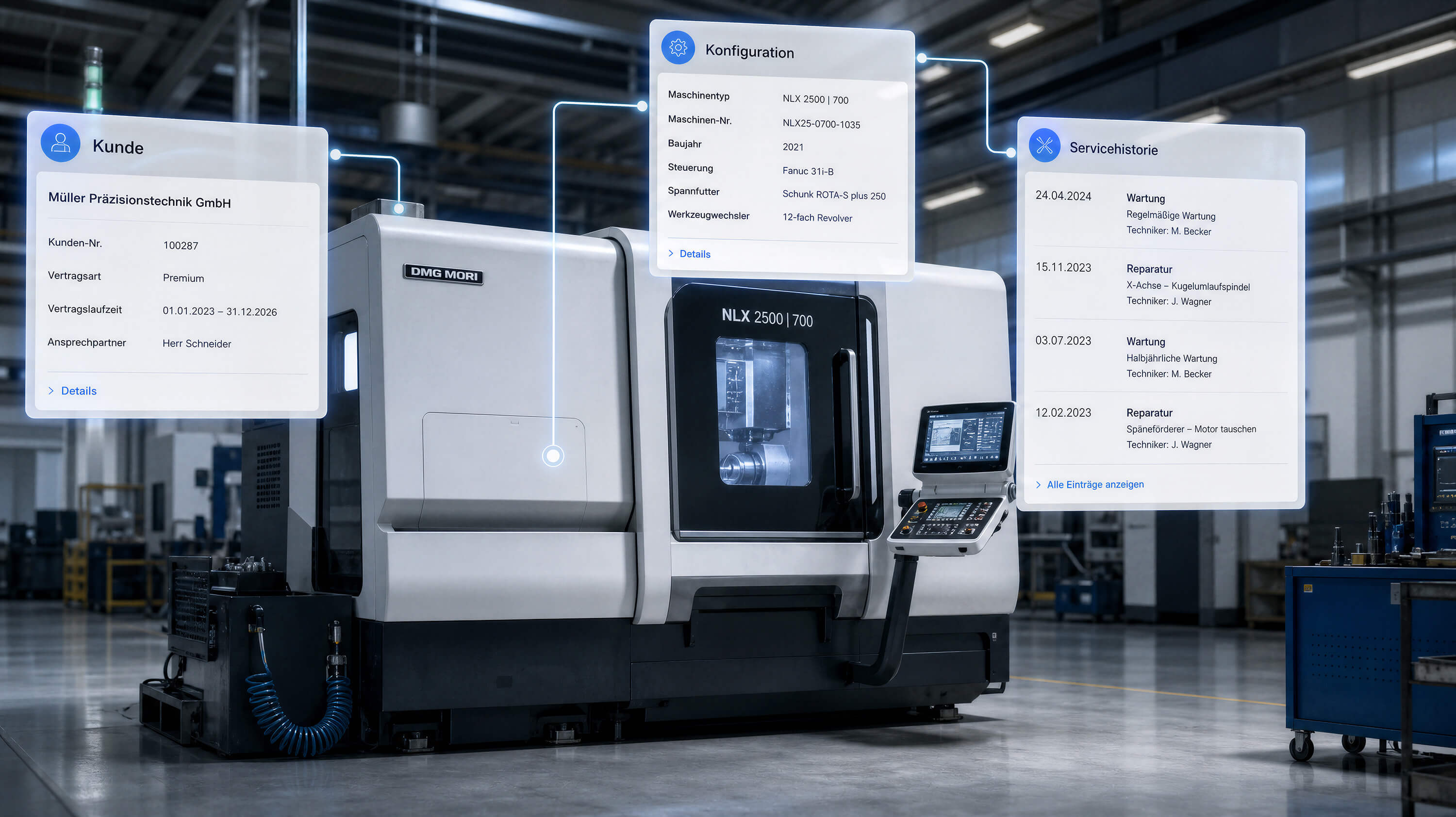
Ask a simple question in almost any established company: Which of our customers operate a machine with configuration B, and which of those machines are due for inspection before the end of the quarter?
The answer almost certainly exists. The customers are in the ERP, the installed configurations in a spreadsheet kept by the service team, the inspection intervals in a maintenance tool — and the knowledge of who recently swapped a component sits with the technician who did it. Someone will answer the question, after half a day of exports, lookups and phone calls.
This is the everyday form of a problem most organisations never name explicitly. They don’t lack data. Most have more than they can use. What they lack are the connections: which record belongs to which, what depends on what, what happened before. They have information, but not context.
A Company Is a Network of Things
Look at how a company actually operates, and it rarely resembles a collection of documents or tables. It looks more like a network.
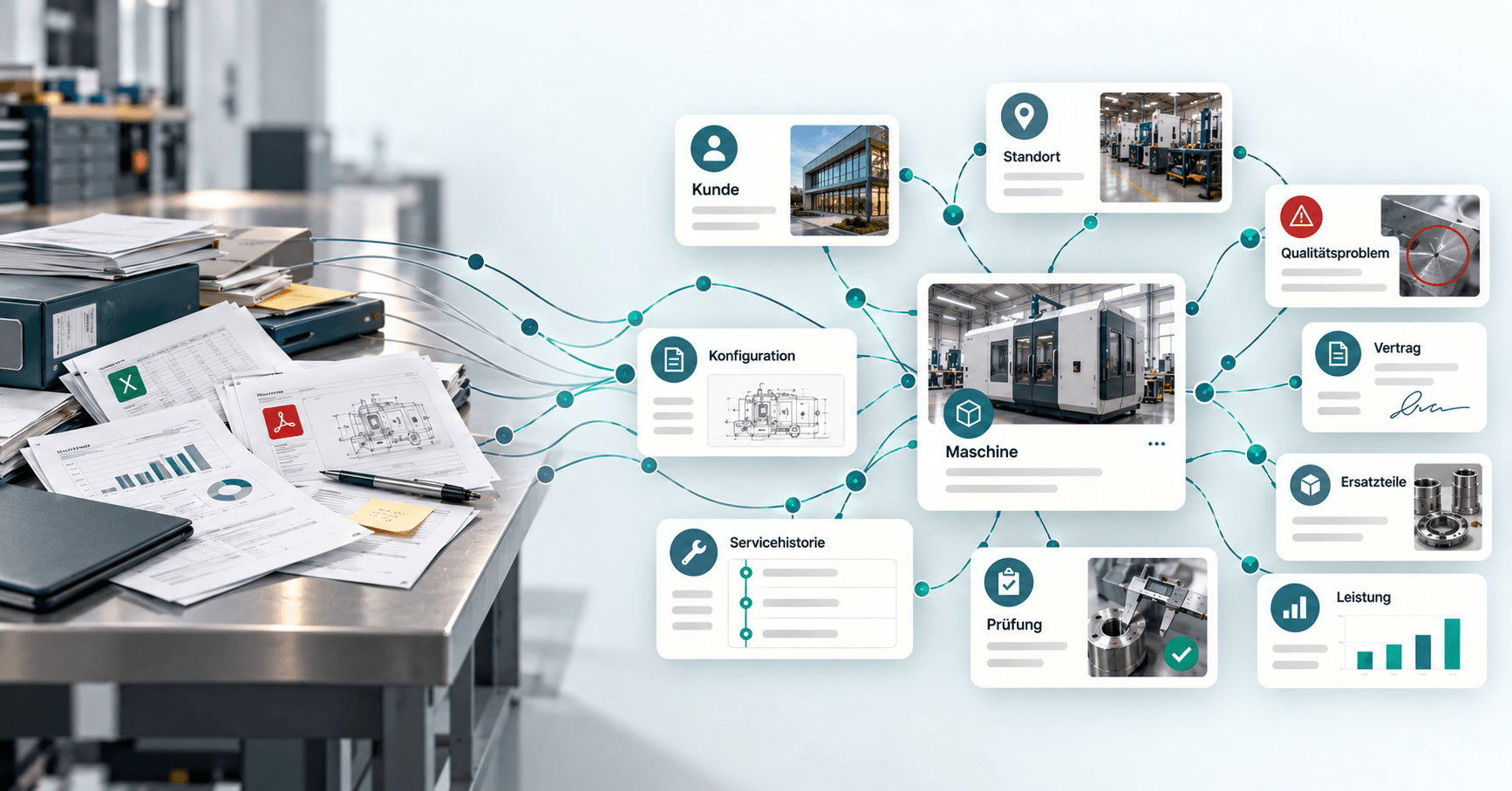
A customer operates an asset. The asset is installed at a location and has a specific configuration. That configuration contains components, each with a serial number and a version. A maintenance requirement applies to the asset; an inspection produces findings; a finding triggers a corrective action. Contracts define obligations around all of it. Certificates, reports and drawings belong to specific points in this network. And employees, suppliers and customers each carry different responsibilities for different parts of it.
This network is the operational reality of the company. Experienced employees carry a partial map of it in their heads. The company’s software rarely does.
From Records to Relationships
Most business software was built for one function and sees the world from that function’s point of view. The ERP knows the customer and the invoice. The CRM knows the contact. The service software knows the maintenance case. The document management system holds the report. A spreadsheet somewhere knows which configuration is actually installed.
Each system can be correct on its own — and the organisation can still lack a coherent picture. The relationships between the records, exactly what people need to answer operational questions, fall into the gaps between systems, where they are reconstructed by hand or exist only in people’s heads.
---
config:
  flowchart:
    wrappingWidth: 240
---
graph LR;
    ERP["ERP
Customer, invoice"];
    CRM["CRM
Contact"];
    SVC["Service software
Maintenance case"];
    DMS["Document storage
Service report"];
    XLS["Spreadsheet
Installed configuration"];

    ERP -. no link .- XLS;
    XLS -. no link .- SVC;
    CRM -. no link .- SVC;
    SVC -. no link .- DMS;

    classDef current fill:#FCE8E8,stroke:#C94A4A,color:#0d2123,stroke-width:1.5px;
    class ERP,CRM,SVC,DMS,XLS current;

    linkStyle 0,1,2,3 stroke:#C94A4A,color:#C94A4A,stroke-width:1.5px;
Integration projects move data between systems, but moving data is not the same as connecting its meaning. Copying a customer number from the ERP into the service tool doesn’t tell anyone which configuration that customer runs or which inspection applies to it.
The shift that matters can be summarised in four steps:
---
config:
  flowchart:
    wrappingWidth: 240
---
graph LR;
    D["Data
isolated values"] --> O["Objects
identifiable things"];
    O --> R["Relationships
how they connect"];
    R --> C["Context
what it means for
the business"];
Data becomes useful when it describes identifiable things, more useful when those things are connected, and genuinely valuable when the connections reflect how the business actually works.
What an Ontology Is — in Business Terms
There is a word for a structured model of this kind: an ontology. The term has academic roots, but in a business setting it can be described plainly:
An ontology is a structured model of the things that exist in a business, how they relate to each other, and what they mean in their operational context.
The difference is easiest to see with an example. A database might contain:
- Customer 4711
- Machine 0815
- Component A
- Service report 2026-104
All correct, all useful to someone — but on their own, not very informative. Now compare the same records, connected:
---
config:
  flowchart:
    wrappingWidth: 240
---
graph LR;
    C["Customer 4711"] -->|operates| M["Machine 0815"];
    M -->|installed at| L["Location Zurich"];
    M -->|runs| K["Configuration B"];
    K -->|contains| A["Component A"];
    A -->|replaced during| S["Service 2026-104"];
    M -->|next inspection| I["Inspection due in March"];
The individual facts are the same. What has changed is that the second version describes a situation someone can act on. That is the central distinction: a database stores information; an ontology represents business context.
An ontology is also specific to each organisation. Two companies in the same industry may define an “asset”, an “order” or a “case” quite differently — and they should, because those differences often reflect how each of them creates value.
Why Relationships Change Everything
Once relationships are explicit, questions that used to require a small project become ordinary lookups. Which customers are affected if a supplier reports a problem with a specific component version? Which contracts carry obligations for assets at a site that is being closed? Which open quality issues concern machines that were reconfigured in the past year?
None of these questions require new data. They require the existing data to be connected in a way that mirrors the business.
The benefit goes beyond reporting. An employee opening a service case sees the asset, its configuration, its history and the related contract at once, instead of assembling that picture from four systems. And change — a new product line, a new service offering — means extending the model rather than adding yet another isolated tool.
An Ontology Is More Than a Data Model
It would be easy to reduce all of this to “flexible database tables”. That misses the point. The value comes from what surrounds the objects and their relationships: an object shouldn’t merely store information, it should exist inside its operational context.
---
config:
  flowchart:
    wrappingWidth: 240
---
graph LR;
    R["Relationships
asset, customer, location"] --- I(("Inspection"));
    P["Permissions
who may see or change it"] --- I;
    D["Documents
reports, certificates"] --- I;
    I --- H["History
what happened before"];
    I --- W["Workflow
what happens next"];
Permissions Are Part of the Context
A model of the business doesn’t only answer what exists. It also has to answer who is allowed to see, change or act on it.
The same service report means something different to the technician who wrote it, the customer whose machine it concerns, the quality manager reviewing it and the supplier whose component it mentions. Each should see what is relevant to them — and nothing else.
When permissions are bolted on afterwards — per application, per export, per shared folder — they drift apart. When they are part of the model, access follows the structure of the business: customers see their own assets, a supplier sees the findings that concern its components.
History Turns a Snapshot into a Story
Knowing the current state of an asset or a case is useful. Knowing how it got there is often more useful. Why was this configuration changed? Who approved the deviation? What did the machine look like before the last service?
A model that records its own history becomes a representation of the business over time. That helps with audits — but the larger benefit is operational: patterns become visible, decisions can be traced back to their context, and knowledge survives when people change roles.
Business Logic Lets the Model Take Part
Business objects don’t simply exist; things happen to them. An inspection becomes due. A machine changes configuration. A quality issue calls for corrective action. A contract changes status. A service case needs approval.
When workflows and rules are attached to the objects they concern, the model is no longer a passive description. The due inspection creates its own task. The finding knows which approval path it requires. The model doesn’t just describe the business — it takes part in running it.
How Exolynk Approaches It
This is the idea at the core of Exolynk. Organisations define their own data models — customers, machines, assets, locations, contracts, products, components, inspections, service cases, quality issues, documents, employees, or whatever objects their operation actually consists of — and connect them through relationships the platform enforces. The platform is deliberately industry-neutral: the point is to model your own operational reality rather than force it into a predefined application structure.
Around that model, the elements described above come together in one place:
- Relationships between objects, so information lives once and is connected wherever it is needed
- Roles and fine-grained permissions, down to the individual record
- Timeline history and audit trails, so every change can be traced
- Workflows triggered by time or by events on the objects themselves
- Documents and integrations — via REST API and webhooks — attached to the objects they belong to
- Controlled custom logic: where configuration isn’t enough, scripts run in an isolated environment with strict limits, so the model can be extended without giving arbitrary code unrestricted access to the platform
The model itself isn’t frozen either. With draft and active states, versioning and release workflows, it can evolve along with the organisation instead of being fixed at go-live.
Why This Matters Even More Once AI Arrives
Everything so far is worth doing without any AI at all. But AI makes a well-structured model of the business considerably more valuable.
Language models are remarkably good at interpreting language, documents and ambiguous information. What they don’t have is knowledge of how your company works. A model doesn’t inherently know which machine belongs to which customer, which configuration is currently installed, which inspection applies to which asset, which source is authoritative when two documents disagree, which user may see a given record, or which actions are permitted in which situation.
Without that context, AI works with fragments — documents found by keyword, an isolated system response, whatever someone pasted into a chat. The results can sound convincing and still be wrong.
With an ontology underneath, the AI can work with actual business objects and their relationships. Instead of “Find documents mentioning machine 0815”, it becomes possible to ask something closer to: “Which machines with this configuration are installed at customers, which components do they contain, and which of them are affected by this maintenance requirement?” — and to get an answer grounded in the same structured data the rest of the organisation relies on, limited to what the person asking is allowed to see.
That is not autonomous decision-making. It is contextual understanding, and the judgement stays with people.
AI provides intelligence. The ontology provides business context.
AI Is an Extension of the Foundation, Not the Reason for It
This leads to a point that is easy to get backwards. Companies shouldn’t structure their operational data for AI. They should structure it because a coherent model of the business improves applications, workflows, reporting, integrations and everyday work — and AI is one more beneficiary.
The order matters because AI moves fast. Today’s models will be replaced, probably several times. A clean, well-governed model of how your organisation operates doesn’t depend on any of that. It stays valuable whichever AI reads from it — and it keeps working if none does. As we argued in Beyond the UI , a business platform should be able to run entirely without AI; AI is an additional way in, not a dependency.
The Digital Model of Your Organisation Should Remain Yours
Over time, an ontology becomes more than an IT asset. Business objects, relationships, permissions, operational history and rules together form a digital model of how the organisation works — including much of what makes it distinctive.
Where that model lives, and who controls it, is therefore a strategic question — not out of suspicion towards any provider, but for a simpler reason: AI models and vendors may change. The digital model of your own organisation should remain yours.
Exolynk is developed and hosted in Switzerland and can run as SaaS, on dedicated infrastructure or on-premises. The model, its history and its rules stay in an environment the organisation controls.
From Ontology to Action
Exolynk doesn’t ask organisations to build an ontology today and work out AI later. The same platform that holds the operational model can connect it to AI in a controlled way: AI steps can be built directly into workflows, and external assistants can work with the model via MCP — under the same permissions, with per-tool rules on what may run without confirmation, and with every action on record. The technical background is in our MCP article .
AI is something Exolynk enables on top of the foundation. It isn’t the reason the foundation exists.
The Next Step
For years, digitalisation has largely meant putting information into software. Most established organisations have taken that step many times over.
The next step is connecting that information into a coherent model of how the organisation actually works — its objects, their relationships, who is responsible for what, and how things change over time. That model improves applications, automation and everyday decisions today. And it creates the foundation on which AI can understand — and, within clear boundaries, eventually act within — the business tomorrow.
Building that foundation, and keeping it in your hands, is what Exolynk is for.