AI QMS in the Automotive Industry
Setting the Scene
At Motherson’s Tech Supplier Days, we had the opportunity to present our QMS solutions to a high-calibre audience of automotive supplier quality professionals. What followed the presentation — a focused roundtable with the quality managers themselves — turned out to be just as valuable as the demo.
The conversation cut straight to what actually matters when you try to bring AI into a regulated, high-stakes production environment. Here is what we learned.
Two Approaches to AI in Quality Management
We walked through two complementary ways to integrate AI into a quality management system. They are not mutually exclusive — in practice, many organisations will want both.
1. AI via Model Context Protocol (MCP)
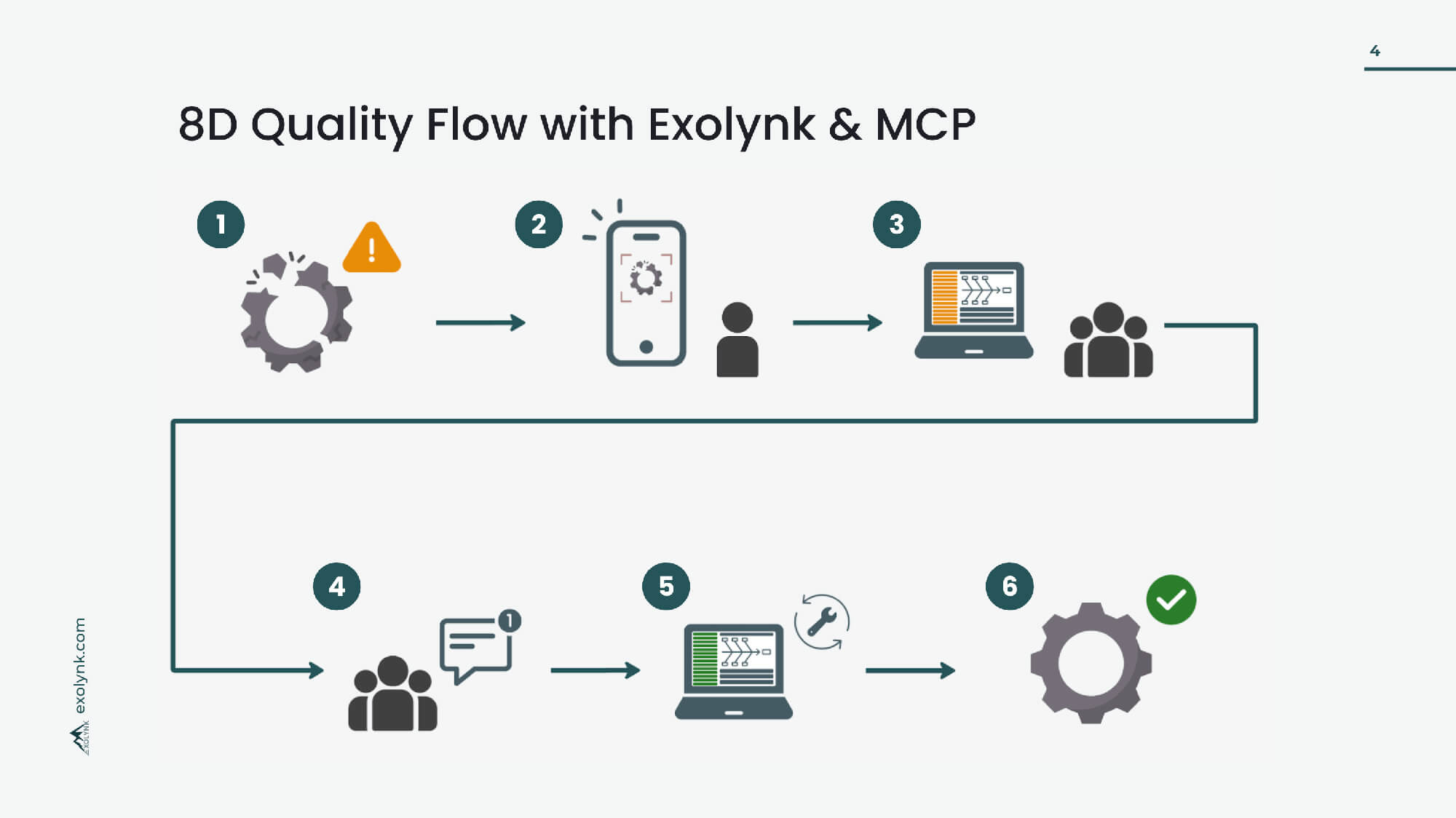
The first approach connects large language models such as ChatGPT or Claude directly to your QMS via the Model Context Protocol . The AI gains read — and, where permitted, write — access to your system data without requiring any copy-paste between tools.
In practice this means a quality engineer can ask the model to analyse an image of a defect, cross-reference it against documented non-conformities, and draft a deviation report — all within a single workflow. The human remains in control at every step: the model proposes, the engineer approves.
The key advantage of MCP is that your team keeps working in familiar tools while gaining AI capabilities on top of real production data.
2. AI Embedded Directly in the QMS
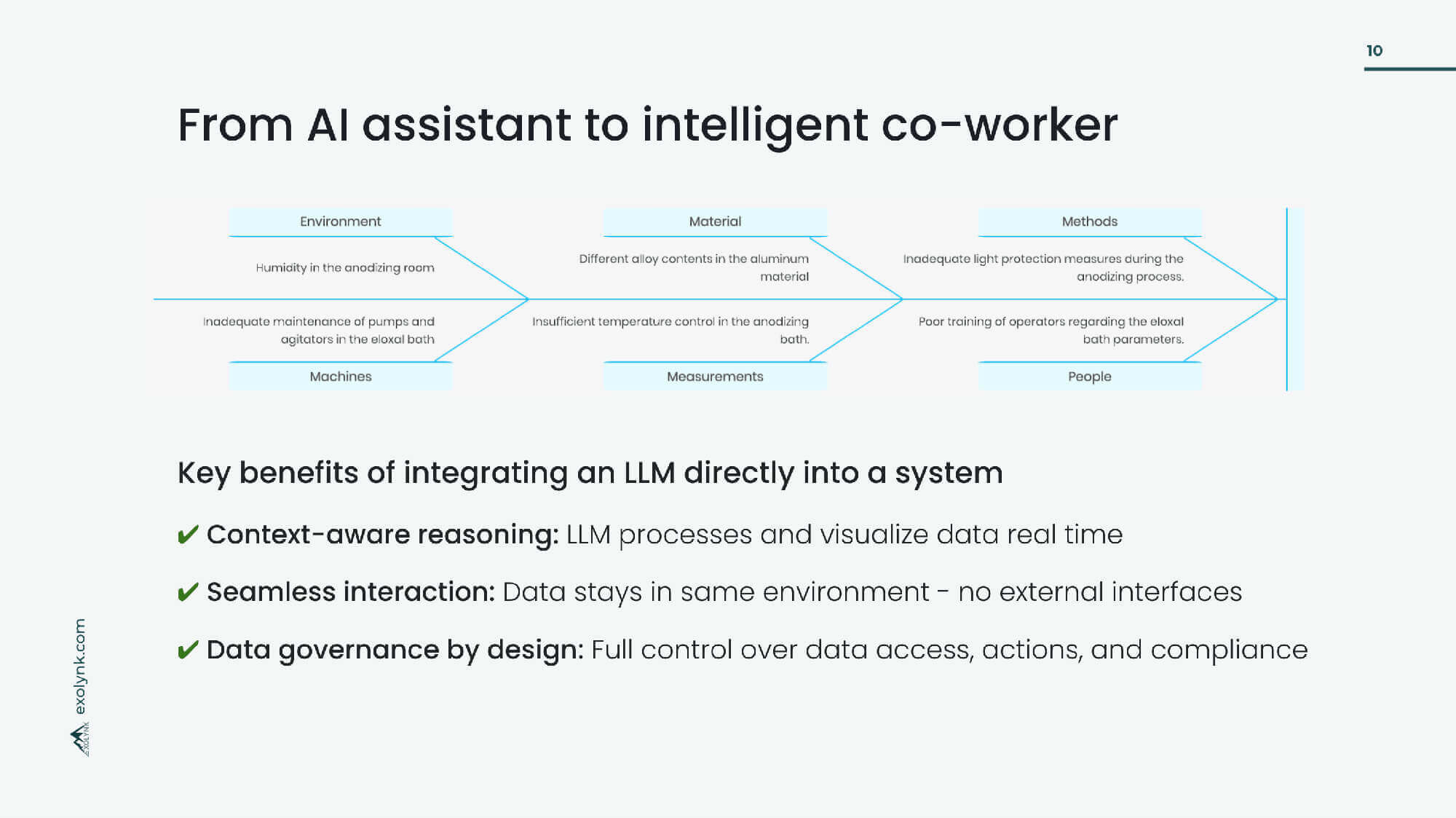
The second approach brings the AI to where the data originates: inside the QMS itself. Rather than connecting an external model, an embedded LLM becomes part of the application.
A concrete example we demonstrated was AI-assisted Root Cause Analysis (RCA). When a quality engineer opens a non-conformity record, the embedded model can suggest probable root causes by drawing on patterns from hundreds of previously documented cases — all within the same screen, without switching context.
This approach works particularly well for structured, repetitive analytical tasks where the model can be tightly constrained to domain-specific data.
What the Industry is Actually Thinking: Roundtable Takeaways
The discussion with quality managers produced three clear priorities that cut across company size and product segment.
Data Security is Non-Negotiable
Strict access control, full audit trails of every AI action, and either on-premise or private-cloud hosting are baseline requirements — not nice-to-haves. The participants were unambiguous: without guaranteed data sovereignty, AI cannot enter a regulated manufacturing environment. This is especially true for tier-one suppliers handling proprietary design data from OEM customers.
Controlled Automation Over Black Boxes
Every AI-generated suggestion must require human sign-off before it enters the quality record. This “human-in-the-loop” principle is not just a preference — it reflects the validation requirements that automotive quality systems operate under. Trust is built incrementally, one approved suggestion at a time.
Seamless Integration into Existing Processes
Quality engineers are already operating under significant workload. A new tool that requires them to leave their established environment, re-enter data, or learn a parallel system will not be adopted — regardless of how capable it is. Direct data access via MCP eliminates media breaks and lets people benefit from AI assistance without disrupting their workflow.
A Day in the Life: The 50-Report Challenge
One quality manager shared a concrete example that stayed with us. In his plant, up to 50 deviation reports are created every single day. Each one requires documentation, categorisation, and initial root cause assessment — largely manual work that consumes time that should be spent on solving problems rather than describing them.
The image recognition and automated report generation capabilities we demonstrated could meaningfully compress that documentation time. The hours saved flow directly back into analysis and corrective action — where experienced quality engineers add real value that no model can replace.
Our Takeaway
The Motherson Tech Supplier Days confirmed something we hear consistently: the automotive supplier industry is ready for AI in quality management. The technology itself is no longer the bottleneck. What matters is how it is integrated — securely, with human oversight, and without friction for the people who use it every day.
The questions quality managers are asking are the right ones. They are not asking whether AI can help; they are asking how to deploy it in a way that holds up under audit, respects data ownership, and actually makes their team’s work better.
Interested in seeing how this works in practice? Take a look at our Manufacturing solution — or dive deeper into one of the core techniques in the article below.

AI RCA with the Ishikawa Diagram
AI-Supported Root Cause Analysis with the Ishikawa Diagram Abstract Root Cause Analysis (RCA) helps companies identify the true causes of problems and solve them sustainably. A proven method is the …